
A Garden That’s Younger Than It Looks
They never weeded a bed or planted a seed, but our four teenagers were heartbroken to leave the big garden of their childhood. Why couldn’t we wait 10 years? Where else would they have their graduation parties and weddings? Despite the objections, off we went to a suburban-size lot with a great house and an insipid garden less than two miles away. While I wanted to downsize, I wanted a place for those celebrations, too, not to mention an appealing setting for early morning coffee and summer dinners—and I wanted it quickly.
Many new gardens seemed laden with rows of puny plants interspersed by large gaps of soil. Was it even possible to go straight to bountiful? With the aid of a trusted garden designer, we created a landscape plan for hastened maturity. She ensured that the lines, scale, and bones were wisely situated, and I focused on the plants and the logistics. Having a framework from the beginning made a huge difference to our success. My hope was that we could skip gawky juvenility altogether—and with clever planning, well-chosen materials, and a cadre of fast-growing plants, that was where we landed.

Learn what hardscaping to keep and what to toss
To begin, we decided on the hardscaping strategy. Changing and adding to the hardscape can be tricky because of budget constraints, but stonework gives the feeling of permanence to a garden. I suggest thinking about what existing hardscape you could alter to make it work. We opted to keep a flagstone patio because it was wonderfully weathered and added a sense of age to the site. Had we started from scratch, it would’ve taken years for the stone to get any character and would have had a huge impact on our budget. Instead, we reduced the patio to a shape and size that was in scale with the rest of the garden, so it was no longer the dominant (and only) focal point.
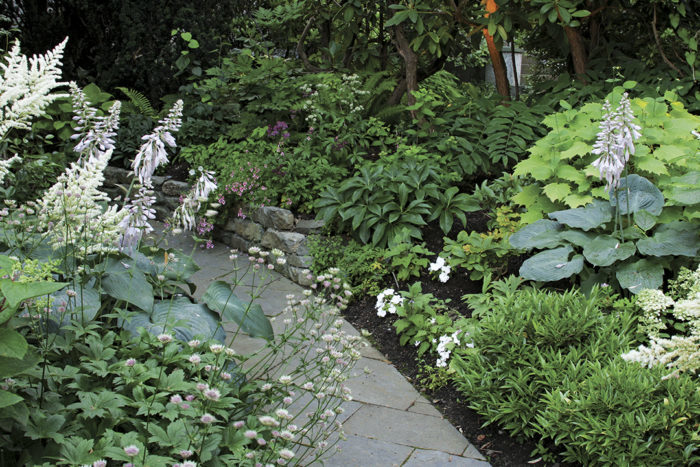
We opted to use stone in a more minor role, as well. In place of grass passageways, we laid flagstone paths. These enabled us to connect various parts of the garden more cohesively but keep it functional in another way, too: Properly placed paths make gardens feel situated. Under the guidance of a skilled stonemason, we also disassembled an old, curving stonewall across the entire back of the garden and re-created it, positioning the stones in a straight line, echoing the lines of both the fence behind it and the now smaller patio. Reusing the same stones increased the “weathered” tone while strengthening the garden’s unity. We built a small destination patio out of stone with a similar patina at the far end of the garden, a cozy scene to look out to and undoubtedly a new locale for that morning coffee. These hardscape choices made an enormous difference in minimizing awareness about the true age of the garden because of the recycled materials that were used.
Rely on hedges and fences for enclosure and scale
Hedging performs a crucial role in attaining the feeling of age in our garden, making the space feel enveloped in green. Hedging can also quickly balance the larger scale of a house—an illusion that makes the garden feel more mature. I opted to buy bushy 6-foot yews (Taxus baccata, USDA Hardiness Zones 6-9), the single biggest cost of our instant maturity plan.
Behind the yew hedge was a preexisting cedar fence, which surrounded the back garden. While functional for privacy, it was a rusty-orange eyesore. Instead of replacing it, we painted it black, an economical choice that added a bit of drama. The fence contributed to the overall mature look of the garden, and the climbers we planted to scale it did as well.
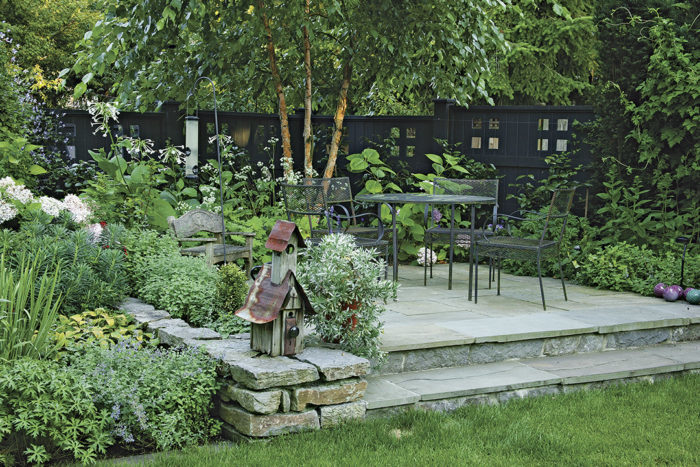
Quick-growing purple potato vine rapidly rambled over the fence and was full of flowers by late spring and stayed that way until midfall. Between the potato vines, I planted a mix of clematis (Clematis spp. and cvs., Zones 4-9) that I brought with us from our old house. Vines grow quickly, giving the garden the illusion of being laden with plants that have a “mature” height. I also used vines in other places throughout the garden: to adorn tall trellises, shimmy up trees, and frolic through other plants that would soon be installed.
The Evolution of a Fast-Maturing Garden
It would be wonderful if we could buy several thousand dollars worth of mature plants and new hardscaping to make a young space feel like it was a 30-year-old garden. Thankfully, there is a way to get a fast-maturing garden with a limited budget, too. The following were the steps we took to make that happen.
Weeks 1-3: Old plants (except a few select trees) removed; existing patio downsized; new pathways installed; stone wall reconstructed
Weeks 3-8: Fence painted; back hedges sited; vines, fast fillers and long-haul plants installed
Link nội dung: https://vosc.edu.vn/the-garden-looks-a68917.html